


 Cart
Cart
 sales@molnova.com


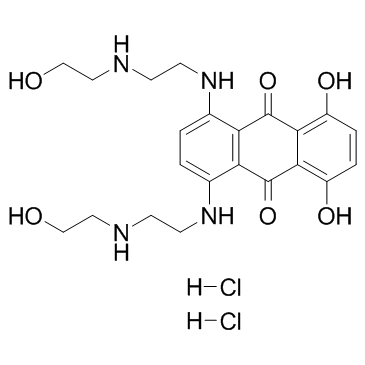
Mitoxantrone hydrochloride
CAS No. 70476-82-3
Mitoxantrone hydrochloride( NCI 301739 | Novantrone | NSC 301739 )
Catalog No. M15709 CAS No. 70476-82-3
Mitoxantrone Dihydrochloride, a type II topoisomerase inhibitor, is an anthracenedione-derived antineoplastic agent.
Purity : >98% (HPLC)
 COA
Datasheet
HNMR
HPLC
MSDS
Handing Instructions
COA
Datasheet
HNMR
HPLC
MSDS
Handing Instructions
| Size | Price / USD | Stock | Quantity |
| 50MG | 45 | In Stock |


|
| 100MG | 65 | In Stock |
|
| 500MG | 165 | In Stock |
|
| 1G | Get Quote | In Stock |
|
Biological Information
-
Product NameMitoxantrone hydrochloride
-
NoteResearch use only, not for human use.
-
Brief DescriptionMitoxantrone Dihydrochloride, a type II topoisomerase inhibitor, is an anthracenedione-derived antineoplastic agent.
-
DescriptionMitoxantrone Dihydrochloride, a type II topoisomerase inhibitor, is an anthracenedione-derived antineoplastic agent.(In Vitro):Mitoxantrone dihydrochloride inhibits PKC in a competitive manner with respect to histone H1, and its Ki value is 6.3 μM and in a non-competitive manner with respect to phosphatidylserine and ATP.Mitoxantrone dihydrochloride (0.5 μg/mL, 48 h) induces a decrease in B-CLL cells. Mitoxantrone dihydrochloride induces DNA fragmentation and the proteolytic cleavage of poly(ADP-ribose) polymerase (PARP), demonstrating that the cytotoxic effect of Mitoxantrone dihydrochloride is due to induction of apoptosis.Mitoxantrone dihydrochloride shows cytotoxicity to human breast carcinoma cell lines MDA-MB-231 and MCF-7 with IC50 values of 18 and 196 nM, respectively.(In Vivo):Mitoxantrone dihydrochloride (IP, 0-3.2 mg/kg/day) produces a statistically significant number of 60-day survivors at 1.6 mg/kg in mice with IP implanted L1210 leukemia.Mitoxantrone dihydrochloride (IV, 0-3.2 mg/kg/day) shows effective antitumor activities and produces a 60% ILS (increase in lifespan) at 3.2 mg/kg in SC implanted Lewis lung carcinoma.
-
In VitroMitoxantrone dihydrochloride inhibits PKC in a competitive manner with respect to histone H1, and its Ki value is 6.3 μM and in a non-competitive manner with respect to phosphatidylserine and ATP.Mitoxantrone dihydrochloride (0.5 μg/mL, 48 h) induces a decrease in B-CLL cells. Mitoxantrone dihydrochloride induces DNA fragmentation and the proteolytic cleavage of poly(ADP-ribose) polymerase (PARP), demonstrating that the cytotoxic effect of Mitoxantrone dihydrochloride is due to induction of apoptosis.Mitoxantrone dihydrochloride shows cytotoxicity to human breast carcinoma cell lines MDA-MB-231 and MCF-7 with IC50 values of 18 and 196 nM, respectively.
-
In VivoMitoxantrone dihydrochloride (IP, 0-3.2 mg/kg/day) produces a statistically significant number of 60-day survivors at 1.6 mg/kg in mice with IP implanted L1210 leukemia.Mitoxantrone dihydrochloride (IV, 0-3.2 mg/kg/day) shows effective antitumor activities and produces a 60% ILS (increase in lifespan) at 3.2 mg/kg in SC implanted Lewis lung carcinoma.
-
SynonymsNCI 301739 | Novantrone | NSC 301739
-
PathwayCell Cycle/DNA Damage
-
TargetTopoisomerase
-
RecptorTopo II
-
Research AreaCancer
-
Indication——
Chemical Information
-
CAS Number70476-82-3
-
Formula Weight517.4
-
Molecular FormulaC22H30Cl2N4O6
-
Purity>98% (HPLC)
-
SolubilityWater: 89 mg/mL (172.01 mM); DMSO: 89 mg/mL (172.01 mM)
-
SMILESCl.Cl.OCCNCCNC1=C2C(=O)C3=C(O)C=CC(O)=C3C(=O)C2=C(NCCNCCO)C=C1
-
Chemical Name——
Shipping & Storage Information
-
Storage(-20℃)
-
ShippingWith Ice Pack
-
Stability≥ 2 years
Reference
1.Seitz M. Curr Opin Rheumatol, 1999, 11(3), 226-232.
molnova catalog



related products
-
Topoisomerase II inh...
Topoisomerase II inhibitor 13 inhibits topoisomerase II (Topo II) that shows strong anti-proliferation activity against HL-60/MX2 cancer cells derived from HL-60 against Topo II toxicity.
-
Topixantrone 2HCl
Topixantrone 2HCl is a DNA topoisomerase inhibitor with antitumor activity for the study of gastric and prostate cancer.
-
Amonafide
A novel topoisomerase II (Topo II) inhibitor and DNA intercalator that induces apoptotic signaling by blocking the binding of Topo II to DNA.
